Society · Indian Society · Lesson 5 of 7 · 13 sections · about 25 min read
Based on: NCERT Class XII India People and Economy (ch. 4) and Social Change and Development in India; Census of India 2011 (urban and slum tables); Constitution Part IXA and Twelfth Schedule; Ministry of Housing and Urban Affairs (Smart Cities Mission, AMRUT and AMRUT 2.0, SBM-U, PMAY-U); Second ARC Sixth Report (Local Governance, 2007); High Powered Expert Committee on Urban Infrastructure (2011); NITI Aayog, Reforms in Urban Planning Capacity in India (2021); RBI Report on Municipal Finances (2022); UN World Urbanization Prospects 2018; Union Budget 2025-26
Urbanisation: meaning and the Indian pattern
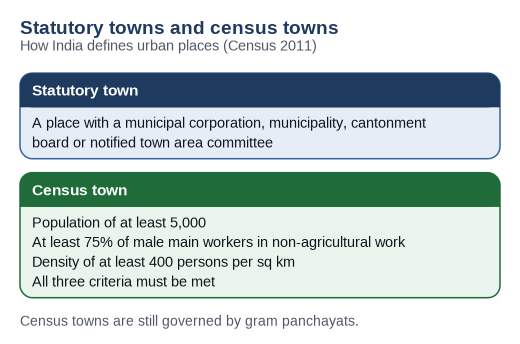
In plain words: Urbanisation is a rise in the share of the population living in towns and cities, not only growth in the number of urban people. This section explains how India defines urban places in the Census, the trend in the urban share from 1901 to 2011, and the parts of urban growth. It also covers the state pattern, the million-plus urban agglomerations, the outlook and the debate about under-counting. Louis Wirth's description of the city as large, dense and heterogeneous is the background for all of it.