Society · Indian Society · Lesson 4 of 7 · 14 sections · about 31 min read
Based on: NCERT Class IX Economics (ch. 3 Poverty as a Challenge) and Class XI Indian Economic Development; Planning Commission reports of the Tendulkar (2009) and Rangarajan (2014) expert groups and Press Note on Poverty Estimates 2011-12; NITI Aayog National MPI reports (2021, 2023) and discussion paper (January 2024); UNDP-OPHI Global MPI; World Bank Poverty and Equity Brief for India (2025); MoSPI HCES 2022-23 and 2023-24 fact sheets; World Inequality Lab (2024); Ramesh Singh, Indian Economy
Poverty: concepts and types
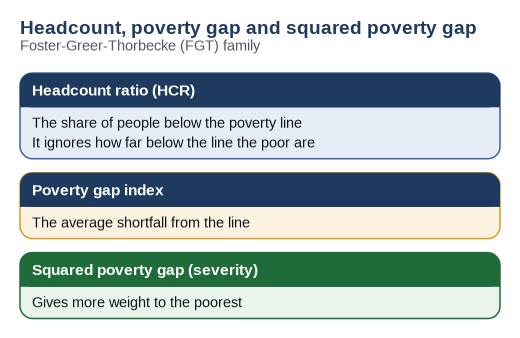
In plain words: Poverty is the inability to meet a socially accepted minimum standard of living. The table sets out the main concepts. Absolute poverty uses a fixed line, relative poverty compares people with others in the same society, and multidimensional poverty counts several deprivations together. Chronic and transient poverty differ in time, and capability deprivation, from Amartya Sen, is the lack of real freedoms to be and do what one values. After the table come the measures of how many people are poor and how far below the line they are.