Society · Indian Society · Lesson 3 of 7 · 13 sections · about 27 min read
Based on: NCERT Class XII Sociology, Indian Society (ch. 2 The Demographic Structure of Indian Society); NCERT Class XII India People and Economy (ch. 1); Census of India 2011; NFHS-5 (2019-21) India Report; SRS Statistical Reports 2021 and 2024 (Office of the Registrar General, 2026); UNFPA-IIPS India Ageing Report 2023; Report of the Technical Group on Population Projections 2011-2036 (2020); National Population Policy 2000; Reports of the Fifteenth and Sixteenth Finance Commissions
Demography and theories of population
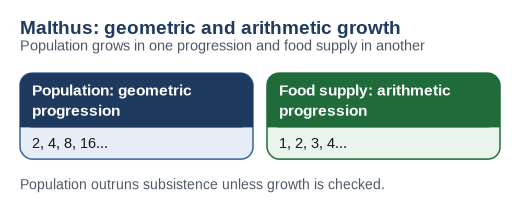
In plain words: Demography is the study of population: its size, composition, distribution and change through births, deaths and migration. Formal demography is the mathematical side, while social demography asks why these change and links them to economy, gender, caste and the State. The section covers Malthus's theory, which says population growth outruns food supply, the criticisms of that theory, and the theory of demographic transition, which describes how growth changes as a society develops.
Demography is the systematic study of population: its size, composition, distribution and change through births (fertility), deaths (mortality) and migration. Formal demography is mathematical; social demography (population studies) asks why these change, linking them to economy, gender, caste and the state. NCERT notes that the census, from 1881 onwards, became a key tool of the colonial and later the planning state.