Polity · Political system · Lesson 8 of 8 · 13 sections · about 30 min read
Based on: Constitution of India (Arts 76, 148-151, 165, 280, 315-323); Protection of Human Rights Act 1993 (amended 2019); Central Vigilance Commission Act 2003; Lokpal and Lokayuktas Act 2013; NITI Aayog Cabinet Resolution 2015; M. Laxmikanth, Indian Polity; official websites of CAG, UPSC, NHRC, CVC, Lokpal and NITI Aayog; PIB
Classifying the bodies
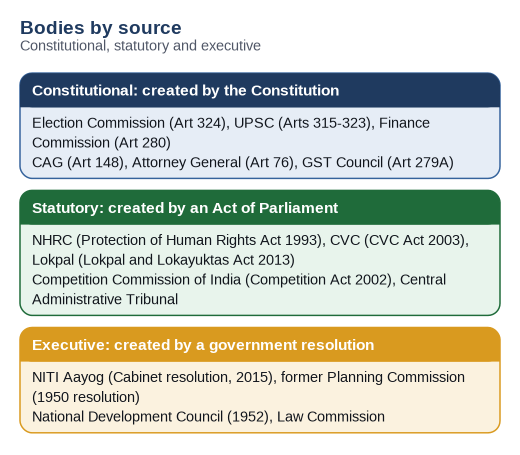
In plain words: A body can be constitutional, created by the Constitution; statutory, created by an Act of Parliament; or executive, created by a government resolution. The source decides how independent the body is and how its members can be removed. The table gives examples of each type with their legal basis.
UPSC regularly asks whether a body is constitutional (created by the Constitution), statutory (created by an Act of Parliament) or executive / non-statutory (created by a government resolution). The source decides how independent it is and how its members can be removed.