International Relations · India and its neighborhood: relations · Lesson 1 of 5 · 13 sections · about 27 min read
Based on: MEA Annual Reports and policy briefs (Neighbourhood First, Act East, SAGAR/MAHASAGAR); SAARC Charter and SAARC Secretariat; BIMSTEC Charter and summit declarations (Colombo 2022, Bangkok 2025); NCERT Class XII Contemporary World Politics (ch. on South Asia); PIB releases; Al Jazeera, The Nation (Thailand) reporting
What "neighbourhood" means for India
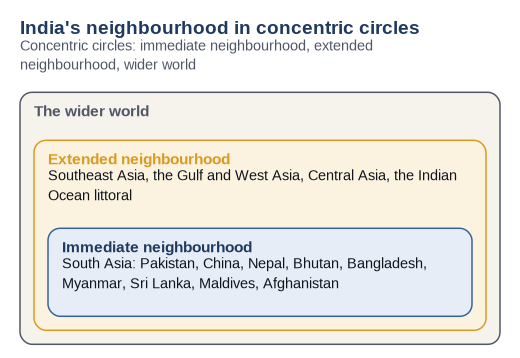
In plain words: India's idea of its neighbourhood works in rings, like circles drawn around one point. The closest ring is South Asia, the countries that share its borders or its problems. The next ring is the extended neighbourhood of Southeast Asia, the Gulf and West Asia, Central Asia and the Indian Ocean littoral. The outer ring is the wider world. The inner ring is where shared problems such as porous borders and cross-border terrorism reach India most directly.
India's foreign policy treats the neighbourhood in concentric circles: the immediate neighbourhood (South Asia: Pakistan, China, Nepal, Bhutan, Bangladesh, Myanmar, Sri Lanka, Maldives, Afghanistan), the extended neighbourhood (Southeast Asia, the Gulf and West Asia, Central Asia, the Indian Ocean littoral) and the wider world.