Science and Technology · General Science · Lesson 7 of 7 · 13 sections · about 26 min read
Based on: NCERT Biology Class XI (The Living World; Biological Classification; Plant Kingdom; Animal Kingdom; Morphology of Flowering Plants; Transport in Plants; Photosynthesis); NCERT Biology Class XII (Sexual Reproduction in Flowering Plants; Evolution; Microbes in Human Welfare); NCERT Science Classes VI-X; CSIR, DST and NIF-India websites; Anusandhan National Research Foundation Act, 2023
Classifying living things: kingdoms and domains
In plain words: Classification sorts living things into groups by shared features, from kingdom down to species, and each species has a two-part Latin name. Whittaker proposed five kingdoms, and the table gives each kingdom's cell type, nutrition and examples. Woese later proposed three domains based on ribosomal RNA, and viruses, viroids and prions sit outside the kingdoms altogether.
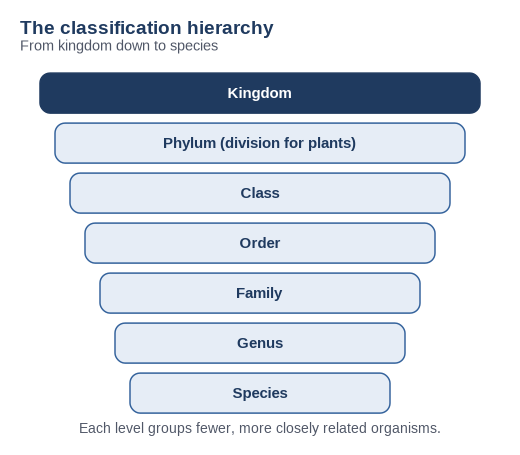
Classification groups organisms by shared features into a hierarchy: kingdom - phylum (division for plants) - class - order - family - genus - species. Every species has a two-part Latin name (binomial nomenclature, Carl Linnaeus, 18th century): genus first with a capital, species second, in italics (Homo sapiens, Panthera tigris, Mangifera indica). Species in one family share close ancestry: the giant panda is in the bear family (Ursidae), while the red panda has its own family (Ailuridae); hyenas and mongooses sit on the cat-like branch of carnivores, not the dog branch.