Environment · Climate change · Lesson 1 of 4 · 11 sections · about 30 min read
Based on: IPCC AR6 Working Group I (2021) and Synthesis Report (2023); WMO Greenhouse Gas Bulletin No. 21 (October 2025); WMO global temperature statements (January 2025, January 2026); NOAA Global Monitoring Laboratory; MoES Assessment of Climate Change over the Indian Region (2020); IMD annual climate statements; India's Fourth Biennial Update Report (2024); NCERT Class XI Fundamentals of Physical Geography
The greenhouse effect: natural and enhanced
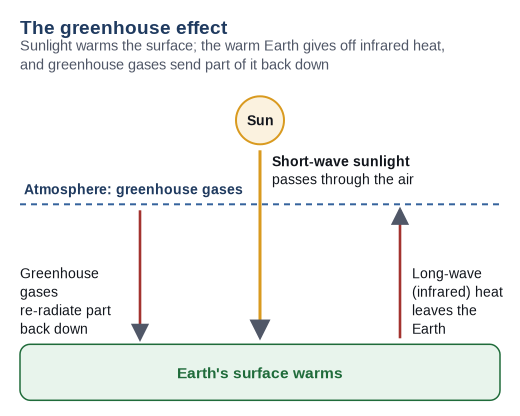
In plain words: Sunlight passes through the air and warms the Earth's surface. The warm surface then gives off energy as infrared heat, and greenhouse gases in the air absorb part of that heat and send it back down. This natural greenhouse effect keeps the planet warm enough for life. Human additions of these gases make it stronger, and the extra warming is called the enhanced greenhouse effect.
The Sun sends energy mostly as short-wave radiation (visible light, some ultraviolet). The atmosphere is largely transparent to it, so most reaches and warms the surface.