Environment · Bio-diversity · Lesson 2 of 4 · 12 sections · about 27 min read
Based on: Wild Life (Protection) Act 1972 as amended in 2002, 2006 and 2022 (indiacode.nic.in); NTCA list of tiger reserves (ntca.gov.in, 2026); UNESCO MAB World Network of Biosphere Reserves (unesco.org); MoEFCC biosphere reserve scheme; NCERT Class XII Biology (Biodiversity and Conservation); Forest Survey of India, ISFR 2023
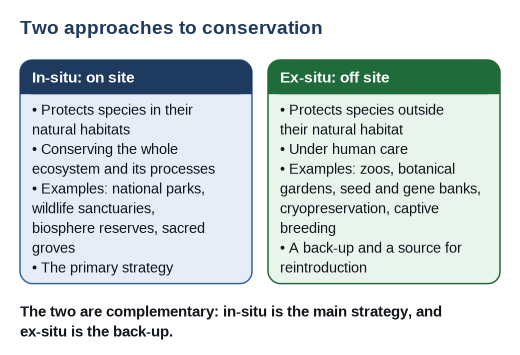
Two approaches to conservation
In plain words: Conservation can happen in two places. In-situ conservation protects a species where it lives, and ex-situ conservation protects it elsewhere, under human care. The two are complementary: in-situ work is the main strategy and ex-situ work is a back-up. The picture sets the two side by side.
In-situ conservation ("on site") protects species in their natural habitats, conserving the whole ecosystem and the ecological and evolutionary processes that sustain them. Examples: national parks, wildlife sanctuaries, conservation and community reserves, biosphere reserves, tiger and elephant reserves, Ramsar wetlands, sacred groves.